The Bottom Drawer Brigade: Six Sutton Keepers Saving the Town’s Everyday History
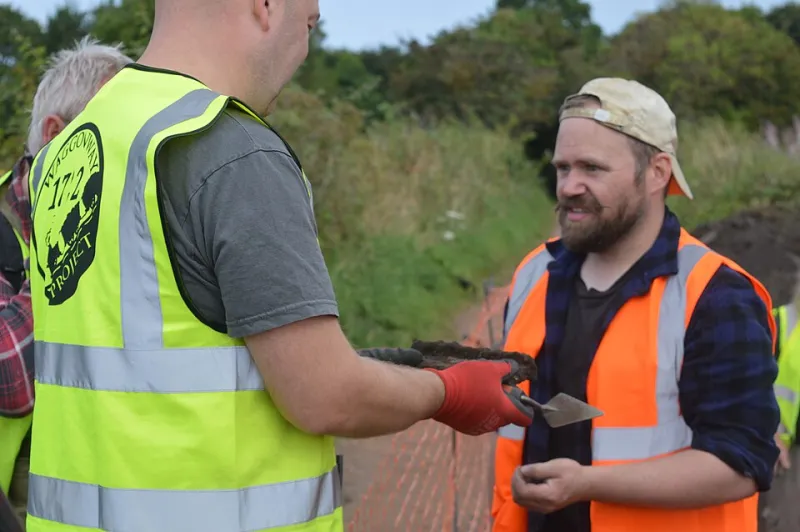
Photo: Dig It! Scotland, CC BY-SA 4.0, via Wikimedia Commons
There is a particular kind of Sutton Coldfield history that never makes it into the guidebooks. It is the queue outside a long-gone butcher’s on Mere Green Road. The sound of a trolleybus conductor’s whistle. The name of the woman who ran the corner shop, and exactly how she liked her windows dressed. It is ordinary, specific and fragile — and it is being kept alive by a small, stubborn band of local people.
They are not formal historians, mostly. They are collectors, listeners, scanners and tea-makers. Between them they hold boxes of photographs, plastic bags of programmes, cassette tapes that have been carefully digitised, and the sort of memories that only surface when somebody asks the right question. This autumn, I went to meet six of them.
The box under the bed in Mere Green
Margaret Hollis has lived in Mere Green for most of her life, and for the past decade she has been the unofficial keeper of its snapshots. Her spare room contains shoeboxes, albums and a filing cabinet labelled, with admirable honesty, “People, Shops, Odd Bits”.
“Everybody thinks their own photos are boring,” she says. “They’re not. They’re the only record of what the pavement looked like before the planters, or which shop had the awning that flapped in the wind.”
Her most surprising find was a packet of holiday snaps from the 1970s that had been left in a house clearance. Tucked among them was a photograph of a street party, complete with a trestle table, bunting and a small boy holding a jelly that appears to be bigger than his head. Nobody in the family knew who the boy was. Margaret put the photo on her table at a local history morning and within an hour three people had claimed him.
“That’s the thing,” she says. “You don’t need a famous building. You need a face somebody recognises.”
Tape, tea and truth in Boldmere
Dave Tranter records voices. He started with his own father, who could remember the town before the bypass, and now runs informal oral history sessions in a church hall in Boldmere. The setup is simple: a decent recorder, two mugs, a plate of biscuits and a list of gentle prompts.
“You don’t say, ‘Tell me about the war’,” Dave explains. “You say, ‘What did your mum send you out for on a Saturday morning?’ That gets you the shop, the street, the weather, the lot.”
He has hours of material now, much of it digitised with help from a volunteer who understands computers better than he does. One of his favourite recordings is a woman describing the winter she and her sister walked home from school across a frozen patch that everyone locally called “the splash”. Dave had never heard the phrase. Neither had anyone else in the room. It turned out to be a shallow dip in a field that had been filled in years before.
“That’s a whole little landscape that only exists on a tape now,” he says. “If nobody had asked, it would have gone.”
The room that remembers in Walmley
Nia Patel organises a monthly memory group at Walmley Community Hall. The format is deliberately low-key: old photographs on the tables, a few objects to handle, and no pressure to perform. People drift in, look at a picture of a school class from the 1950s and suddenly remember the name of a teacher they have not thought about in fifty years.
“We had a set of photographs of the old shops and one gentleman went very quiet,” Nia says. “Then he said, ‘That’s the window my mother cleaned.’ He hadn’t seen it since he was a boy.”
The group is not just for older residents. Nia has started inviting younger people from local schools to come and listen, partly because the questions are better when they come from someone who has never known a town without a supermarket on every corner. The best sessions, she says, are the ones where somebody says, “I never knew that was there.”
Maps, menus and the odd surprise at the library
Colin Price is the sort of archivist who can make a trade directory sound like a thriller. He volunteers at the local history desk at Sutton Coldfield Library, where he looks after maps, programmes, council leaflets and a fine collection of menus from restaurants that no longer exist.
His favourite discovery was a folded map with handwritten notes in the margin. Someone had marked the route of a carnival procession in the 1960s, including the point where the float got stuck under a tree. Colin cross-referenced it with a newspaper photograph and found the exact tree — still standing, slightly larger, and now on a route that nobody would think to celebrate.
“People think history is about dates,” he says. “It’s not. It’s about where you stood to watch the parade.”
He is also practical. If you have a photograph with no name on the back, or a programme from a club that folded in the 1980s, Colin wants to see it. He will not necessarily keep it. He will scan it, note what you know and give it back.
The scan-and-chat mornings in Four Oaks
Ruth Baxter runs what she calls “scan and chat” mornings in Four Oaks. Bring a photo, she says, and she will put it through a scanner while you have a cup of tea. The digital copy goes into a growing community collection; the original stays with you.
The sessions have turned up some genuinely odd things. There is a photograph of a shopfront with a hand-painted sign for a product nobody can identify. There is a picture of a family car parked outside a house that seems to have moved six feet to the left. There is a wedding group in which one guest is clearly holding a small dog that has been cropped out of every other copy.
“The little mistakes are often the best bits,” Ruth says. “They tell you how people actually lived, not how they posed.”
An hour is enough
What all six keep saying is that preservation is not a specialist hobby. You do not need a degree in archive studies. You need a photo you are willing to have scanned, a memory you are willing to have recorded, or an hour to sit and listen while somebody else remembers.
“People say they haven’t got anything interesting,” Margaret says. “They always have. They just don’t know it yet.”
So if you have a carrier bag of old snaps under the stairs, a programme from a school play, a receipt from a shop you loved, or simply a clear memory of a Sutton street before the roundabout, say something. Ask at the local history desk, buttonhole a volunteer at a memory morning, or turn up to a scan-and-chat session with your box of odd bits. The town’s everyday history is not kept in a vault. It is kept in bottom drawers and kitchen-table conversations — and it only survives if somebody hands it on.