Red Paint, Old Iron: Six Sutton Coldfield Postboxes Worth Looking Up For
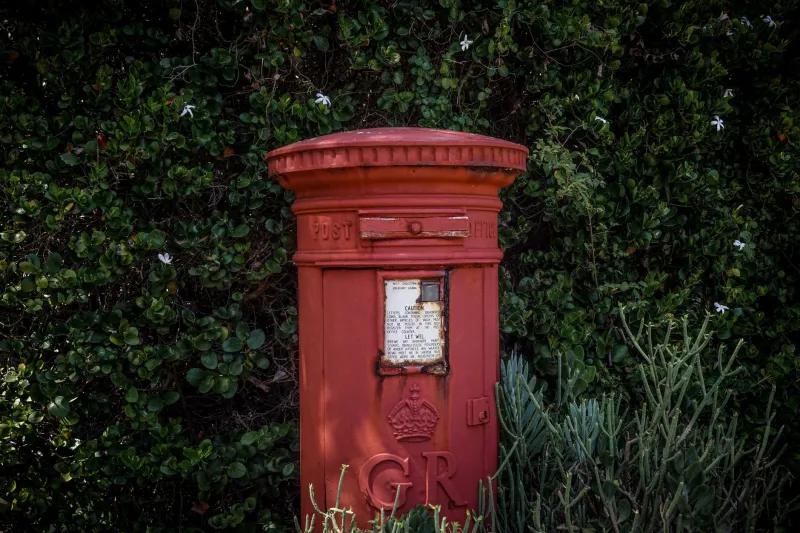
There is a small habit worth acquiring in Sutton Coldfield: walk a few paces past a postbox, stop, and turn round to look at it properly. Above the slot, usually half hidden by a coat of pillar-box red, sits a monogram. VR. GR. EIIR. Those few letters are a date stamp, and once you start noticing them, the town's street corners stop being scenery and start being a timeline.
This is a free, any-weekend sort of treasure hunt. No booking, no ticket, no gift shop. Just a decent pair of shoes and a willingness to look slightly odd on a pavement.
Where to start, and how long it takes
Begin at Sutton Coldfield railway station and finish at Blake Street, which gives you roughly three miles and about two hours at a gentle pace — longer if you stop for a coffee in Boldmere, which you will. The route is almost entirely flat and pavement-friendly, and it can be split neatly in two: town centre and Maney on one outing, Boldmere and the northern stations on another.
One rule before you set off: look, don't touch. These boxes are working street furniture, many of them well over a century old, and some are individually listed. No rubbing, no scratching at the paint to reveal a cypher, no stickers.
1. The one set into a garden wall
A short hop from the station, on the residential streets behind the Parade, you'll find the classic Victorian wall box — a cast-iron letter slot sunk into a brick wall, with a shallow hood above it and a small enamel plate below. Wall boxes exist because they were cheap to install and impossible to knock over. The cypher here is a clean, unshowy VR, and the brickwork around it has been repointed so many times that the box now looks older than the wall holding it.
2. The station box with the honest paintwork
Back at the station approach, a pillar box of the tall, fluted variety stands slightly off the platform. What makes this one worth a pause is the layering: you can see where decades of repainting have softened the crisp edges of the royal cypher into something almost hand-drawn. If the collection-time plate at the base looks newer than the box, that's because it is — plates get swapped, iron doesn't.
3. Maney's quiet rarity
Here's the one to bring a friend for. Tucked on a residential corner near Maney, there is a box carrying the cypher of Edward VIII — a reign that lasted less than a year in 1936, which is why so few of these boxes were ever made and fewer still survive. There are only a couple of hundred across the whole country. It is not signposted, it is not celebrated, and there is every chance you have driven past it a thousand times.
The monogram is small and easy to miss. Look for the letters rather than the shape. And yes, it is entirely reasonable to take a photograph. Plenty of people do.
4. Boldmere's hexagonal survivor
Heading out towards Boldmere, keep an eye out for a pillar box with flat faces rather than a smooth cylinder — a design dating from the 1860s and 1870s, when boxes were built like little cast-iron buildings with a roof on top. These are the ones that most often get listed, and they photograph beautifully against a row of independent shopfronts.
It's also the natural halfway point. Boldmere Road has enough cafés to make the second half of the walk a negotiation.
5. Wylde Green's lamp box
Smaller and stranger: a lamp box, designed to be bolted to a steel post and barely bigger than a paperback. These were the Victorians' answer to awkward pavements where a pillar box simply wouldn't fit. There's one in the Wylde Green area doing exactly that job, still swallowing birthday cards 120-odd years later.
6. The box with no name at all
Finish near Blake Street with the quietest curiosity of the lot: a box carrying no royal cypher whatsoever. A small number were made in the late 1870s and 1880s, apparently to sidestep a bureaucratic row about whose initials should go on them. What you're looking at, then, is a design decision made by committee and never repeated.
How to read a cypher in ten seconds
- VR — Victoria, 1837 to 1901. The most common old cypher you'll spot.
- EVIIR — Edward VII, 1901 to 1910. Often quite decorative.
- GR — George V, 1910 to 1936. A plain, workmanlike monogram.
- GR with a VI — George VI, 1936 to 1952. Easy to muddle with the above; look for the numerals.
- EIIR — Elizabeth II, 1952 to 2022. The ones most of us grew up ignoring.
- Nothing at all — pre-1887, or a replacement door fitted later in life. Both are common.
If you spot something rare or damaged
Two things are worth reporting, and neither takes long. If a box is damaged — a leaning pillar, a broken door, graffiti, a slot jammed with rubbish — Royal Mail has an online reporting form and does act on it. If you think you've found a box of genuine historic interest that isn't already protected, Historic England runs a formal listing application process, and local amenity societies are usually delighted to help with the paperwork.
What you shouldn't do is attempt a tidy-up. Well-meaning scrubbing has stripped more historic paint than weather ever has.
The point of it all
Sutton Coldfield is a town that gets walked through rather than looked at. This loop asks you to do the opposite for a couple of hours, and the reward is a set of small, free discoveries on streets you already know. Take a flask. Take a friend who likes old things. And next time you post a birthday card, glance up first.