Before the Milk Float: On the Road With Sutton's Winter Salt Crew
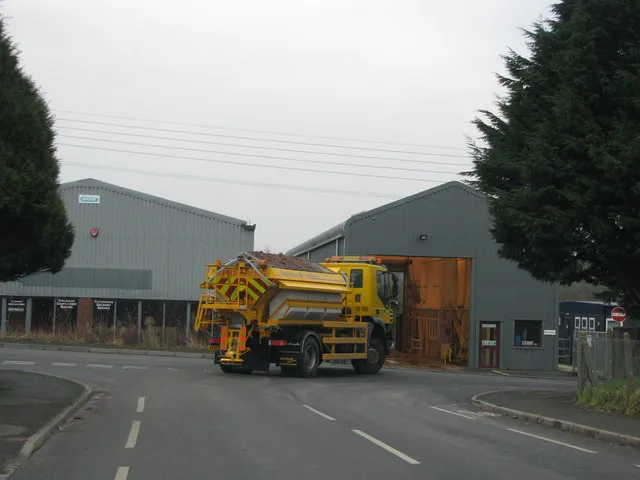
Photo: Sarah Charlesworth , CC BY-SA 2.0, via Wikimedia Commons
It’s 3.47am on a Tuesday in late November, and the yard on the edge of town smells of diesel, wet stone and the particular cold that comes off a barn full of salt. The thermometer on the wall reads minus two. The man climbing into the cab says that’s the warm part.
I had asked to come along on the first run of the season’s first proper cold snap — partly out of nosiness, mostly because I wanted to know who is awake at that hour, keeping the roads open while the rest of us are still arguing with the duvet.
First, the salt
A gritting lorry is a bin lorry that has been to the gym. Behind the cab sits a hopper the size of a small van, and above it a barn — genuinely church-sized — heaped with rock salt in a long brown slope, like a crushed-up beach under a roof. Loading takes minutes. The driver walks round with a torch, checks the spinner, ticks the sheet, and then we are off, amber lights turning, at roughly the speed of a brisk cyclist.
That speed is not laziness. Go faster and the salt bounces off the crown of the road and into the gutter, where it does nobody any good at all. The whole job is done at twelve, fourteen miles an hour, which means a route across the town takes the best part of three hours.
How a road earns its grit
Here is the thing most of us get wrong: nobody grits every street. No council in the country does — there isn’t the money, the salt, or the hours in the night.
What gets treated first is the spine of the town: the bus routes, the A roads, the approaches to the stations, the roads an ambulance or a fire engine would actually use, the junctions where a slide becomes a crash, and the hills. Sutton sits high, on clay and old sandstone, and the streets fall away from the centre in every direction — which is why gradients matter more here than they would in a flatter town.
“People think we do their cul-de-sac,” the driver says, indicating with two fingers on the wheel. “We don’t. We do the roads that get everybody else moving.”
Around a third of the network is on the primary list. The rest gets looked at if there’s time, if the forecast is truly grim, or if a local crew has already filled the bin on the corner. Which is why those grit bins on Sutton’s estates matter more than most of us realise: for a lot of streets, the bin is the plan.
The steep ones come first
Ask anyone who drives for a living which Sutton roads make them nervous in the cold and you get a list. The climb up past the station at Four Oaks. The run down towards Wyndley. The bends out Streetly way. The drag up from the Lichfield Road. Anything with a camber, a bend and a bus on it.
“A flat road with a bit of ice is an inconvenience,” one of the supervisors tells me later, back at the depot. “A steep road with a bit of ice is a closed road — and then it’s a closed school and a missed hospital appointment. So yes. The hills come first. They always will.”
What it’s actually like in the cab
Loud. The engine, the spinner, the constant rattle of the body. No radio — you couldn’t hear it, and you need to hear everything else. The driver watches the mirrors more than the road ahead, because the salt is behind him, and the only way to know it’s going down evenly is to look.
Twice we stop and get out. Once to hand-throw grit at a junction the spinner can’t reach properly, once to check on a man walking a very old dog along a stretch with no pavement. Both times the driver says the same thing, almost to himself: it’s the people on foot who carry the risk, not the cars.
The decision nobody notices
The crews don’t choose to go out. Somebody at the council reads the forecasts — road surface temperatures, not air temperature, which is the number that actually matters — and makes a call, usually by early afternoon for the night ahead.
Go out and nothing freezes: money spent, nobody notices. Stay in and it freezes: everybody notices. It is not a hard calculation to understand and it is a horrible one to get wrong. Salt has limits, too. Below about minus five it works slowly, and if heavy rain follows you down the road, you have effectively donated it to the drains.
Four things worth doing
- Park so a lorry can get past. A gritter stopped on a hill is a gritter not doing its job.
- Use the grit bin, but don’t empty it onto your own drive and leave the corner glassy.
- Give way to the amber lights. Nobody is racing you.
- Clear the pavement outside your house — and next door’s, if they’re older than you are.
Dawn
By half seven the sky over the town is the colour of weak tea, the buses are running, and the school run is complaining about traffic rather than ice. The lorry goes back to the yard, refills, and the driver hands over to the day crew before going home to sleep through the morning.
“Somebody has to be out first,” he says, switching off the beacons. “Might as well be us.”